Canon Ef 2470mm F28l Ii Usm Versus Sigma Art 2470
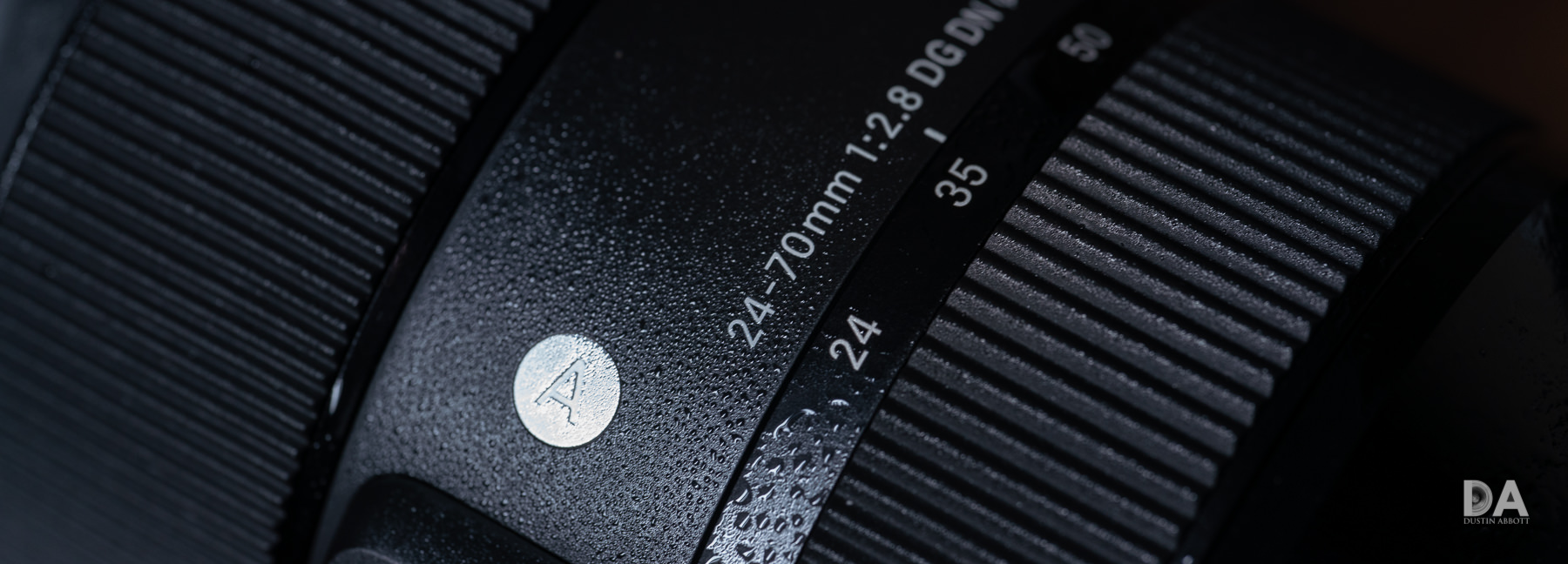
There are few lenses more than important to photography than the 24-70mm F2.8 standard zoom, which covers everything from landscape focal lengths to one of the favored focal lengths for portrait photography. Most photographers could practise at least 80% of their photography with such a lens. Sigma has followed up their fantabulous xiv-24mm F2.8 DN wide bending zoom with a standard zoom at the 24-70mm focal length. The Sigma 24-70DN (as we'll call it for brevity) is going to make a lot of people question whether they are willing to pay twice equally much for the GM lens ($2198 USD) when the similarly built and performing Sigma is available for $1099 USD.
This is an incredibly useful focal range, going from 24mm:

…to 70mm:

In many ways the new Sigma 24-70mm F2.eight DN ART becomes a more direct competitor to the very expensive Sony Fe 24-70mm F2.viii M Master lens due to having a more than similar focal length, maximum aperture, optical performance, and feature set than the extremely popular Tamron 28-75mm F2.8. At the same fourth dimension, all the same, some of the same arguments for choosing the Tamron over the GM lens remain true with the Sigma (size, weight), though the biggest one (price) is much less true. The Tamron is available for $879 while the Sigma costs $1099 (in the Us Marketplace), which is plain a much smaller gap than comparing a $879 lens to a $2198 i. So is the Sigma the lens to buy in the category?
Very maybe, though the respond is a little more nuanced than that. Read on to find out why…
If y'all would like to watch the review, you can choose either the long format or quick format review videos:
I've reviewed the 24-70mm DN on my Sony a7RIII and Sony a9 bodies. Thanks to Sigma Canada for the loaner test lens.
Follow Me @ Patreon | My Newsletter | Instagram | Facebook | Twitter | Flickr | 500px
Sigma 24-70DN Build and Handling
While researching the 24-70DN during my review, I came beyond this language on Sigma's website: "By exerting superiority in mirrorless photographic camera-dedicated designs, the lens size and weight are successfully reduced…" I'm going to have to give them a Pinocchio or two on this, as that'due south only partially true, and even the fractional truth isn't the whole truth. Take a expect at this:
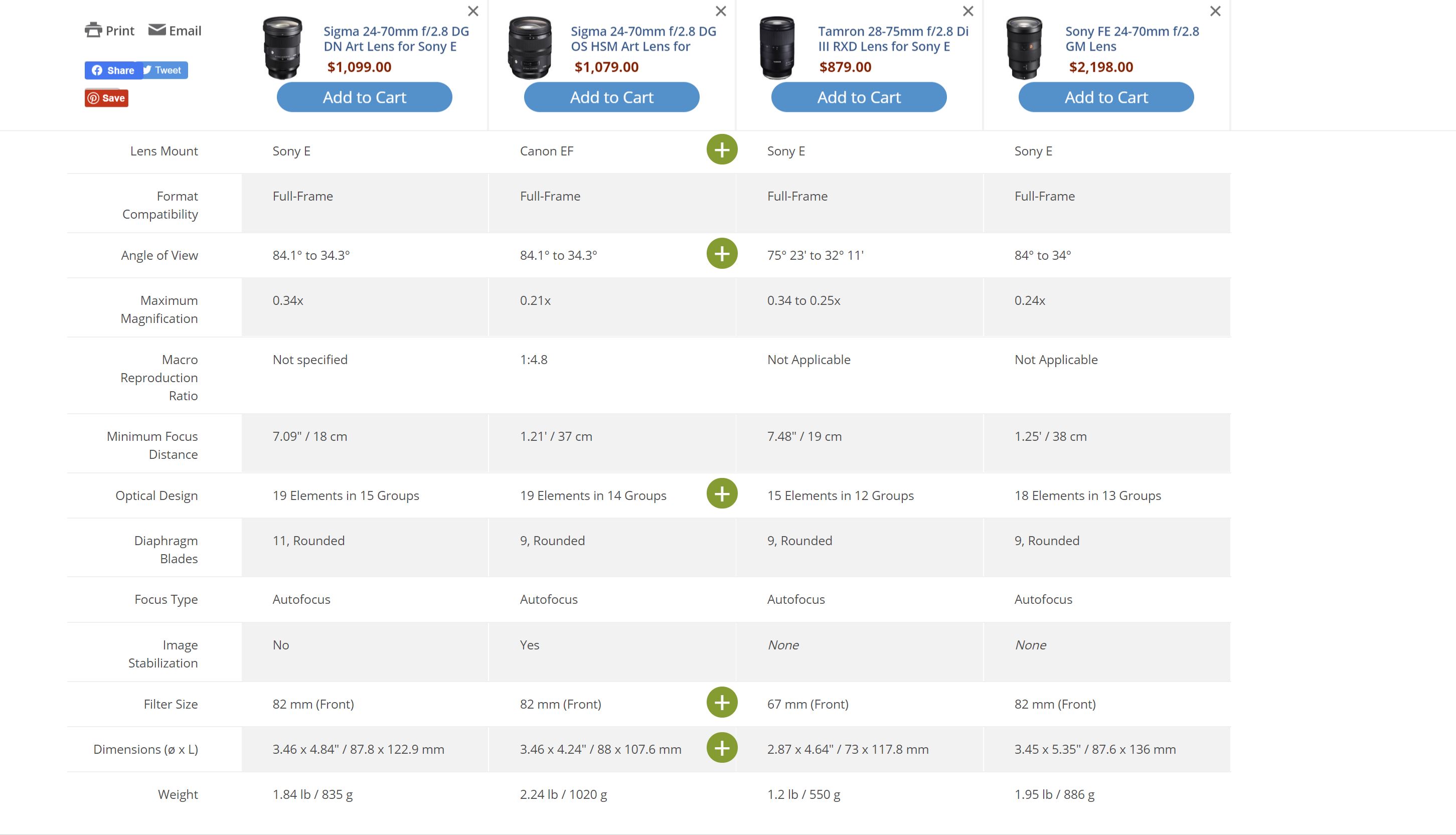
A careful look at the specs reveals that the DN lens is actually quite a bit longer than the Canon EF mount version (122.9mm vs 107.6mm) and is a scant 0.2mm narrower (a rounding error). The internal volume of the lens is certainly more, not less. Information technology is considerably lighter (835g vs 1020g), so that'due south the true part, though, in full disclosure, the Canon EF version included an OS (optical stabilizer) unit that Sigma is able to forego here due to so many Sony bodies having IBIS (in-trunk-image-stabilization). The DN lens has a slightly leaner looking contour, merely that is primarily due to it being considerably longer rather than really beingness narrower.
What is mayhap improve marketing is the fact that the Sigma lens is shorter (13mm) and lighter (by 50g) than the Sony GM lens, though that still makes it a fairly big lens. And it is here that the Tamron may even so prove more attractive to some perspective buyers, as while it isn't much shorter (117.8mm, or about 5mm shorter), it is both narrower (15mm) and more than than 50% lighter (550g). Information technology uses a 67mm filter size (which is shared across all of Tamron's other FE lenses) compared to the 82mm of the Sigma. If you often use a smaller purse and want to travel calorie-free, the Tamron is noticeably smaller, and that is most obvious when the lens hoods are reversed for storage. The Tamron's lens hood is a full 2cm (20mm) less wide from edge to edge.
And so, if your vision of mirrorless is small and light, the Tamron may still exist the more bonny lens despite the Sigma existence more pro-grade in its build and features.
And it is more pro-class. The 24-70DN has a familiar ART serial expect, though with a little more upscale experience. There's a coating similar to fluorine on the front element to get in resistant to oils and water (easier to clean). There'south a mix of metals (including brass in the lens mount) and engineered plastics that results in a sturdy, robust build. You'll notice a gasket at the lens mountain and a diagram from Sigma reveals that at that place are a total of 8 seal points throughout the lens, including at the rings and switches.
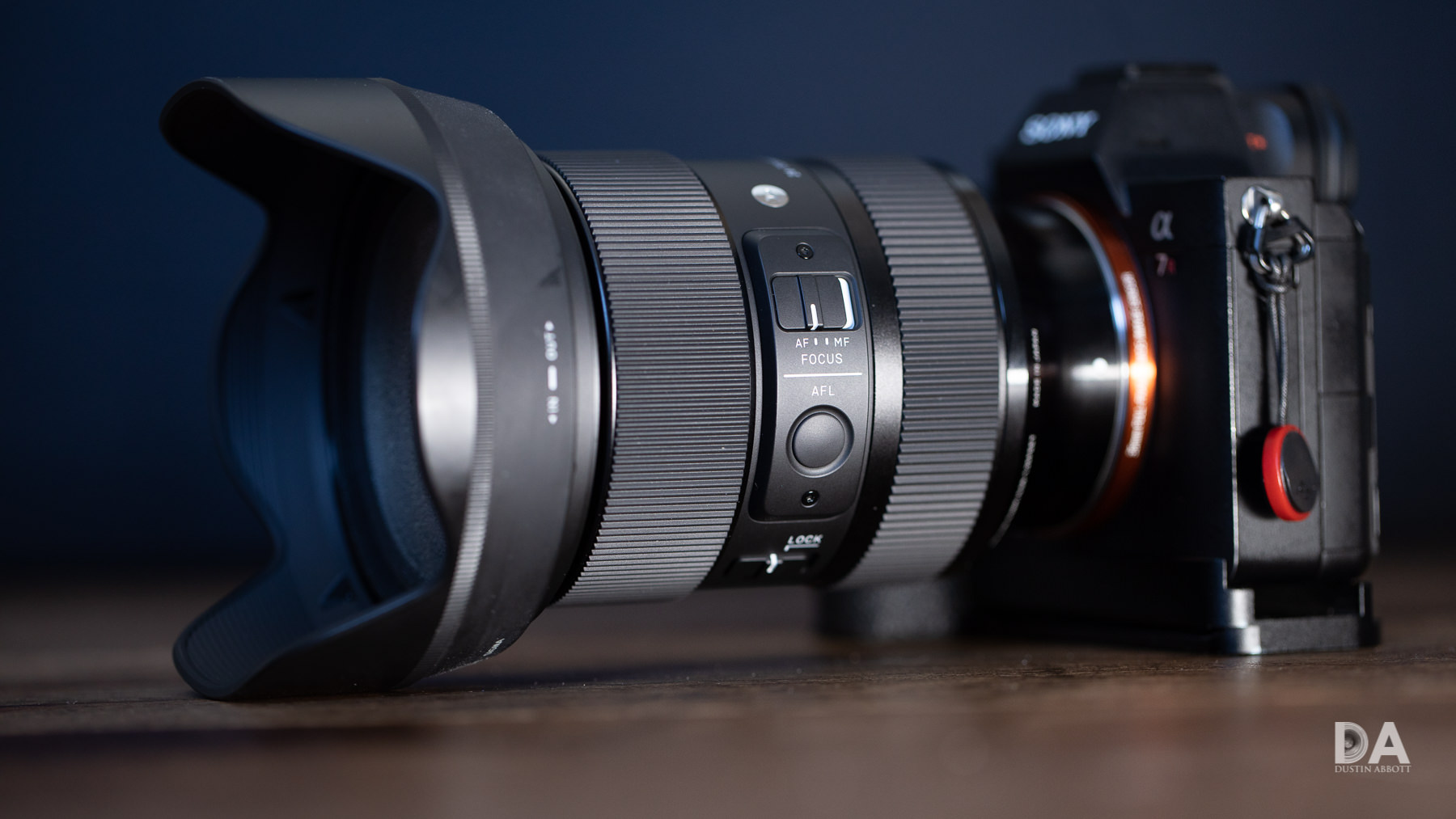
The Sigma is also more like the GM lens and less like the Tamron when it comes to the feature prepare. While the Tamron has no switches or controls other than the zoom and focus rings, the Sigma sports a robust feature set. There is an AF/MF switch (always welcome), a focus hold button that tin can exist programmed to a variety of functions in the camera body, and a locking mechanism to foreclose the lens from inadvertently zooming.
There is no tendency towards zoom creep, simply the lock does aid when hiking with the lens to prevent rubbing on the focus ring while moving which might cause it to zoom out.
The focus ring has thick ribs in a rubberized end, and is (like all lenses really designed for mirrorless) a "focus-by-wire" focus ring where input on the focus ring is routed through the focus motor. This method has a little less tactile response but Sigma has done a pretty fair job of giving a smooth, evenly damped focus experience. When input is detected the agile focus expanse will automatically magnify in the viewfinder or LCD screen and an on-screen distance scale will appear. It is worth noting that the focus ring is in the reverse position from the Tamron. It is closest to the front of the lens while the zoom ring is closest to the lens mount. What's odd is that they plow in contrary directions, too, with the Tamron turning the same direction as the Sony zooms I've tested and the Sigma turning in the opposite direction.
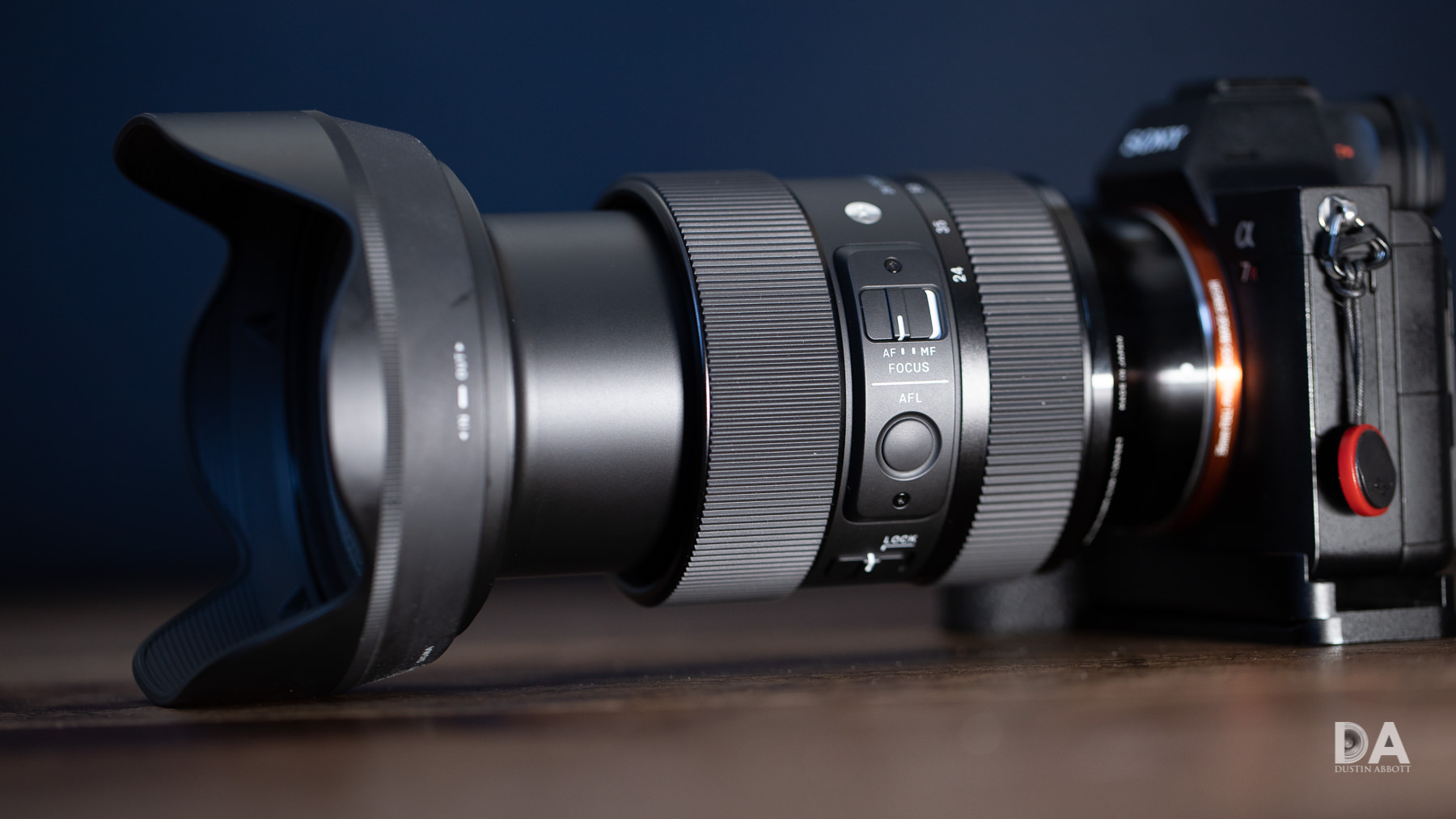
I found this a petty ergonomically disconcerting and noticed it more I did on the 14-24mm, probably because that lens was internally zooming and required less forcefulness to zoom information technology. People'due south opinions vary, obviously, but I actually prefer the zoom position of the Tamron because I institute the Sigma'southward zoom ring a little close to the photographic camera mountain and often inadvertently reached for the focus ring (nearer the front) instead.
1 other factor here is that the additional girth of the Sigma 24-70DN means that one doesn't accept much room for their knuckles between the grip and the lens barrel. This is more a Sony problem than a Sigma trouble, equally the Sony bodies I used for the review (a9 and a7RIII) don't have plenty room between the lens mount and the camera grip for N American sized hands.
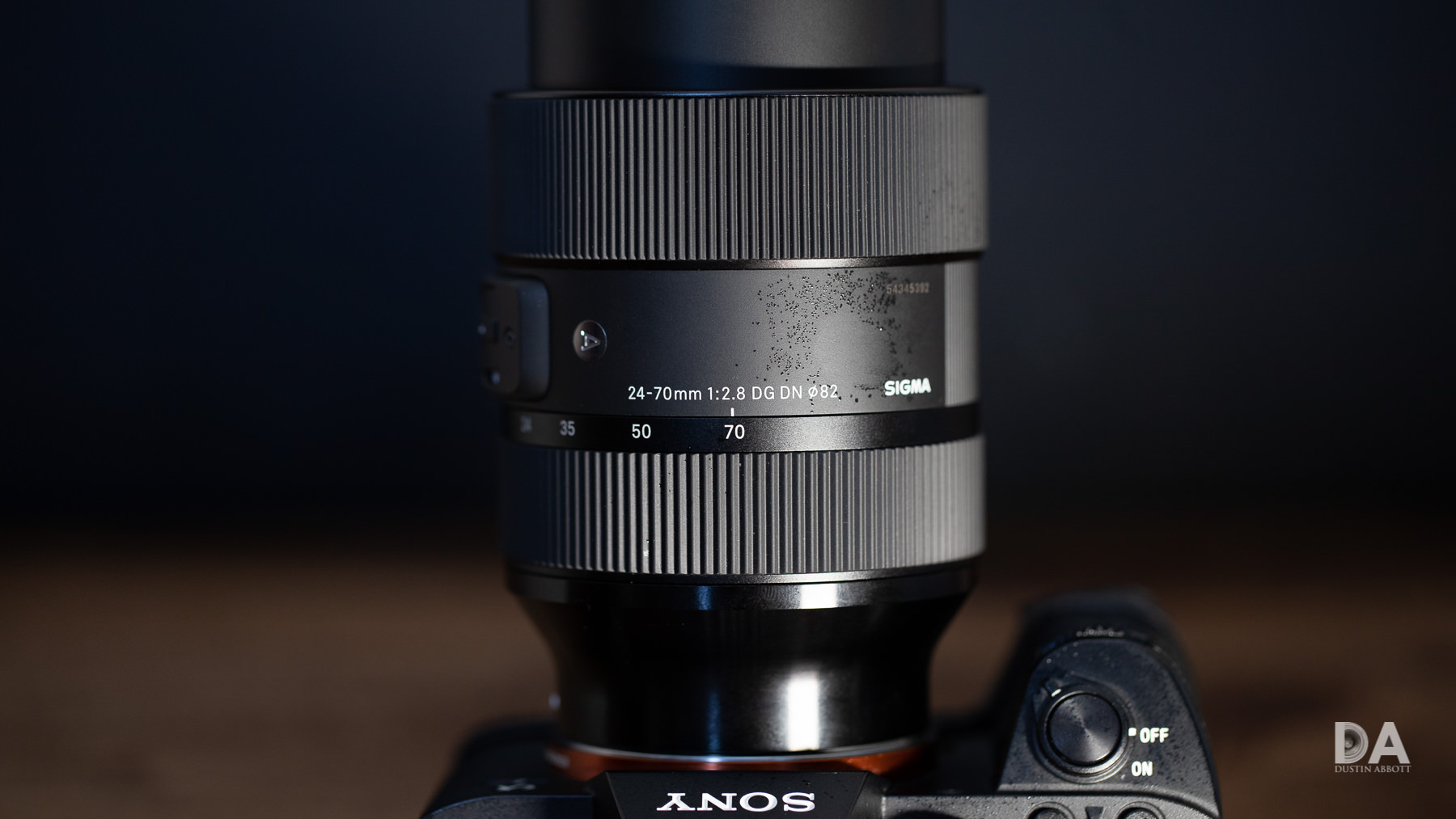
Like the Tamron, Sigma utilizes ii different minimum focus distances, with the lens able to focus closer (0.18m) at 24mm where it achieves its college magnification figure (1:2.9 or 0.34x – the same as the Tamron).
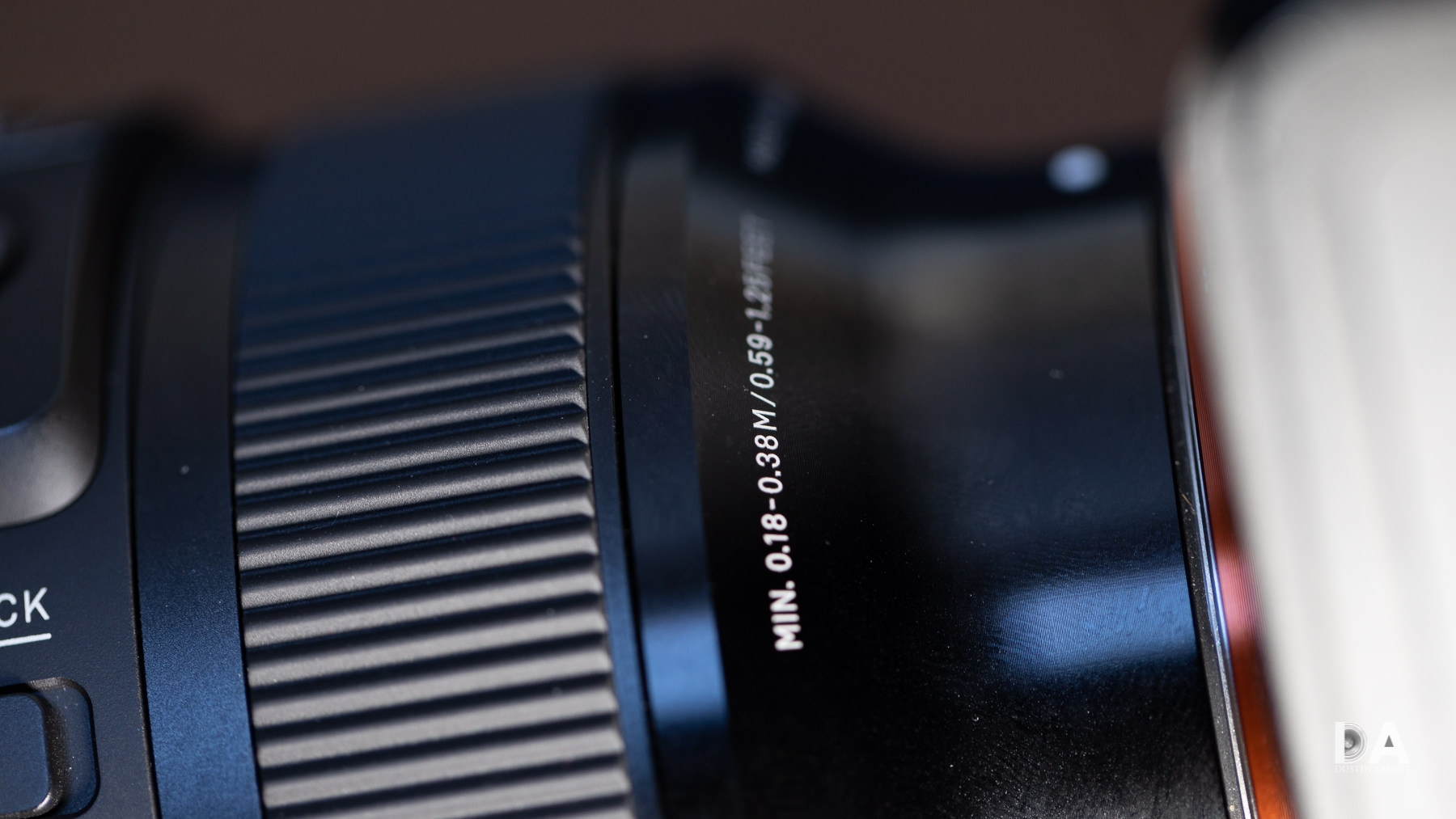
Unfortunately this is a piffling less than useful, as the lens itself is 0.13m long (and MFD measures from the sensor which adds another 0.015m), resulting in non fifty-fifty enough room left to fit your lens hood between you and the subject. Here's what MFD looks similar at 24mm and the resulting degree of magnification:
This is obviously non especially practical for many situations, though better to accept it than non have information technology. At 70mm the MFD grows to 0.38m and the magnification figure drops to one:four.5 or 0.22x magnification.

That's useful, only non as expert as the Tamron (0.25x at 75mm) or the Sony GM (0.24x at 70mm). I noted that out in the field I had a very hard time getting a sharp close focus result, and I think I somewhen diagnosed the problem. At 70mm there is a massive amount of field curvature up close that creates an effect almost like motion mistiness in the corners. This image looks like information technology was shot with a Lensbaby.

This makes limerick more of a challenge, and then yous might want to call back to go on your subject nigh the center of the frame, though that is evidently less than ideal for composition sometimes. What'south ironic is that the Sigma is really sharper at 70mm than the Tamron is at 75mm (as we'll run across in a moment), and that's true in a controlled examination (in the center of the frame at least) at MFD. Because of the quirk, yet, I actually have a much easier time getting real world sharper images with the Tamron considering of the flatter plane of focus.
The Sigma comes with a nice padded case and also a more upscale lens hood than the Tamron. It has a ribbed portion to add together both texture for removing information technology and likewise a bit of visual distinction and has a rubberized transition surface well-nigh where the hood mounts on the lens. This also makes for a nicer tactile experience when removing the hood. There is a locking machinery that will clinch the lens hood doesn't get accidentally knocked.
Small complaints aside, still, the lens handles really well. Information technology is a beautifully made, pro-grade lens that feels very quality in the hands. There is very lilliputian "extra" near the GM lens compared to the 24-70DN.
Sigma 24-70DN Autofocus Peformance
Sigma'due south "fabricated-for-mirrorless" lenses have all shown very positive autofocus performance. The focus motors are quick, quiet, and polish. That remains the instance here, and, like the build, I have much more expert than bad to mention.
Commencement of all, autofocus was fast in all tested situations. In that location'south little drama in focus. The lens simply gets to where it needs to go silently and without fuss. When I did my focus pull test and tried to pick up sound with the on-board microphone, there was just nothing to hear. Focus pulls were smooth, with little visible stepping, and there was little to no settling or pulsing. Video focus was also very stable when I used the 24-70DN to tape several of my video episodes, without any unnecessary pulsing or jitters.
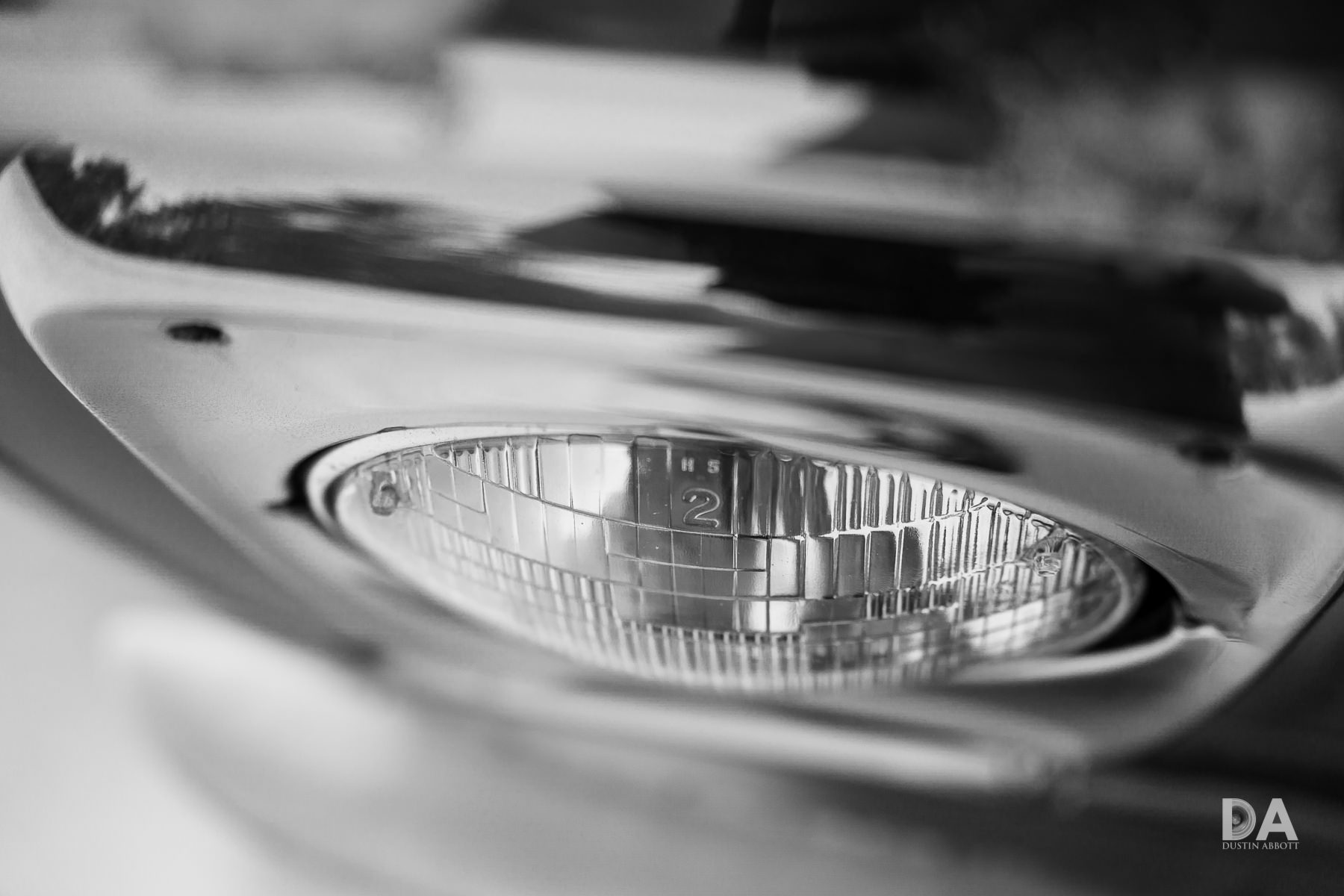
Focus speed is splendid, and compares very favorably to 24-70mm lenses I've used on DSLRs. When comparing the Sigma with the very speedy Tamron 28-75, I could not really tell a applied divergence.
I was also very impressed with the focus in low light situations. I was able to quickly lock focus in a nigh night room without whatsoever obvious slowdown. This shot was taken on a Sony a9 at ISO 25,600 and 1/8th of a 2nd (a -5.33 exposure value).

Not a very artful shot, evidently, merely information technology'due south impressive that focus worked and so well. Besides worth noting is that, thank you to Sony'due south excellent IBIS, the shot is very steady at 70mm and 1/eighth 2nd. Ironically the stabilization is better in this iteration than the Bone (optical stabilizer) on Sigma's 24-70mm F2.8 OS Fine art.
I have just i complaint near focus, and that was in close focus situations. The 24-70DN seemed reluctant to focus on close objects at times. I could sometimes resolve this by putting a focus bespeak exactly on where I wanted focus, but there were times (like this one), where I even so couldn't get good focus lock.

This contributed to the problem mentioned above where I found information technology hard to get proficient results at close focus distances.
The contrary was truthful when using Heart AF for either humans or pets. I got flawless focus results in these situations, with non i miss during my review catamenia. Here's an instance of man Eye AF:
…and of pet Centre AF:
It'due south worth noting some other reality hither. The shot I simply shared is literally the very starting time photo that I took with the lens. Thank you to the mirrorless focus systems and excellent AF in a lens similar this, there is no demand for scale or "learning" the lens. Just put it on the photographic camera and reap proficient focus results. If nothing else, this makes my job equally a reviewer (and a photographer!) so much easier!
I got excellent focus results in other portrait situations as well:
And then the overall conclusion is that focus is excellent hither. I'm hoping that the close focus situation tin be improved via firmware just similar Tamron did with the 28-75, but in most situations I had fantastic focus results.
Sigma 24-70DN Image Quality Breakdown
The reviews were a little mixed when it came to the Sigma 24-70mm F2.8 Os Fine art and its optical operation. I directly compared it with the excellent Canon EF 24-70mm F2.8L II along with the Tamron SP 24-70mm F2.8 G2 lens, and it came out on the lesser of that comparing. I read and watched other such comparisons that drew largely the same conclusion. But Sigma has tightened things up hither and delivered a lens with improved optical consistency.
Fifty-fifty at F2.8, it is easy to become actually excellent results similar this:

I like to start by looking at distortion and vignette. There is definitely some very pronounced barrel distortion at 24mm along with noticeable vignette. Both of these are more than pronounced than the Tamron at 28mm (first chart), but as y'all can see from the second nautical chart, there is a noticeable difference in framing width between 24mm and 28mm.
While at the time of my review period at that place wasn't nonetheless a standard correction profile in Lightroom, both JPEG and video receive in camera corrections (equally you tin can see from the third image in the series in a higher place). This profile does a fairly good job of correcting for distortion and vignette, though I don't think this lens would exist a smashing pick for architecture or interiors because in that location is as well much correction needed.
I said information technology in my review of the Tamron, and I'll say it hither: I would definitely take the actress 4mm on the wide cease over the extra 5mm on the telephoto finish when comparison these two zoom ranges. I understand why Tamron did what they did (information technology'south the reason why we got a smaller and lighter lens while retaining strong optical functioning), but Sigma has addressed the challenges of the focal range more straight even though that required them to build a larger and heavier lens. The practiced news for us all is that we get to choose which approach better suits our needs.
The baloney turns to balmy pincushion distortion of varying degrees over the balance of the zoom range. The vignette improves as the lens is stopped downwards, though some remains even at smaller apertures. Logic would dictate that the much larger front chemical element of the Sigma would give it an advantage over the smaller Tamron in terms of vignette, but that wasn't actually the case in my comparisons.
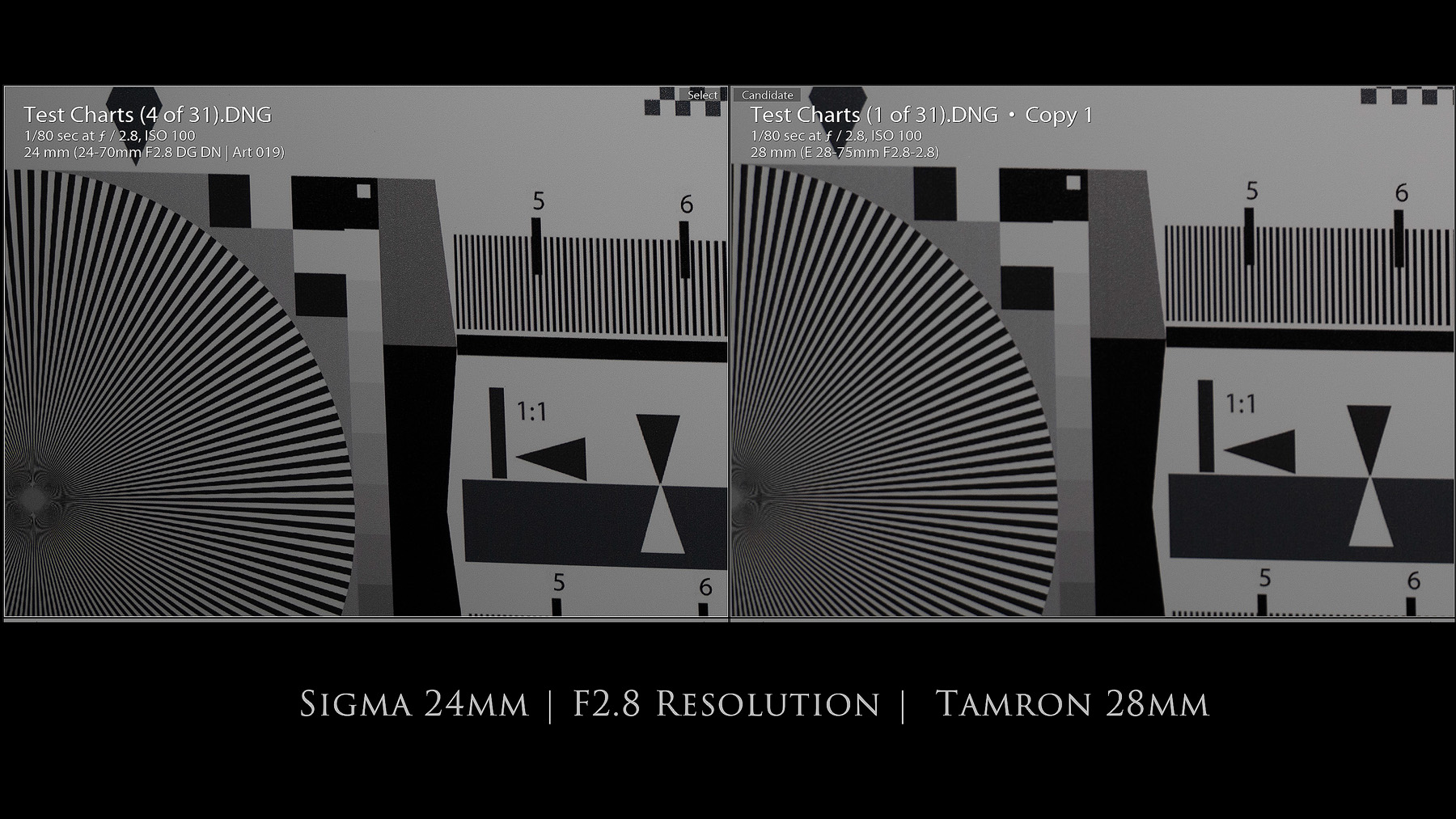
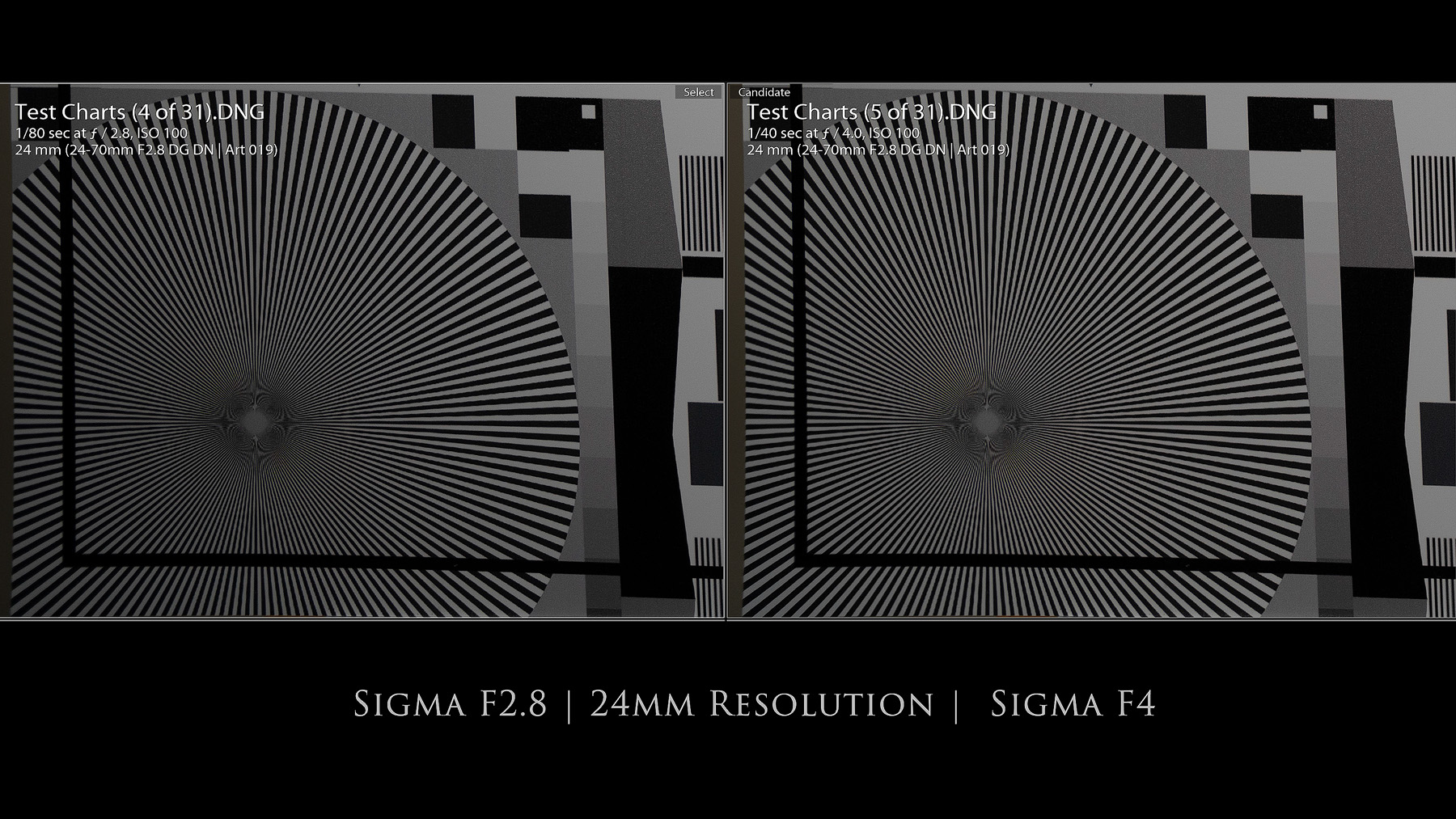
Both lenses are very sharp at 24/28mm and F2.viii. I saw niggling to distinguish the two, with some give and take depending on where I looked in the frame. Both lenses showed skilful evidence of centering, with all 4 corners delivering roughly equal results. I did these formal tests on a 42Mpx Sony a7RIII. I did feel that the Sigma delivered slightly better contrast results at the broad stop of the focal range, merely, as you tin meet from this crop from my test chart, there was little stardom to be made:
Real earth 24mm F2.8 results were splendid:
Little changes in the center and mid-frame at F4, but the corners definitely improve through both improved contrast and a vignette elevator.
At that place'south a similar improvement at F5.6. Landscape images at 24mm and smaller apertures are detailed and rich.
At 35mm, the well-nigh notable difference between the two lenses is that the Tamron delivers a clearly brighter image with equal settings. The 82mm front end chemical element vs the 67mm of the Tamron would seem to favor the Sigma, but I did notation a tendency through the zoom range that the Tamron delivered a brighter image with equal settings. This could be a side upshot of more elements (19 Elements in 15 Groups) of the Sigma vs the Tamron's 15 Elements in 12 Groups, or information technology could be something else that I'm missing.
I experimented and found that it wasn't quite ane/3 stop deviation. Enough to exist noticeable next, but probably not a "big deal". I saw footling difference betwixt the two lenses in terms of sharpness or contrast though I looked long and hard. Both were excellent. Little is gained in the middle of the frame when stopping the lens down, though the corners volition definitely improve a bit.
Permit's step back from the vacuum of the test chart, though, and look at the real world. Existent world sharpness and contrast are fantabulous fifty-fifty at F2.viii at 35mm on the 24-70DN.
At 50mm, the Tamron enjoys its biggest advantage, and it is an incredibly slight one. Textures expect slightly amend defined on the Tamron, though I doubtable the slightly amend light transmission is probably the unmarried biggest distinguishing cistron. By F4 the 24-70DN's image has brightened up beautiful and the dissimilarity pops in both the eye and corners. Another very strong performance.
As you lot might have guessed already, real world results at 50mm expect excellent:
It is at 70mm (vs 75mm) where Sigma gets its revenge. It is easily stronger than the Tamron, and this is in fact the well-nigh noticeable difference between the two lenses optically, and arguably at one of the well-nigh important points in the focal range. At that place are only minor gains in the centre stopping the lens down, but the corners get to fantastic levels by F5.6.
Equally y'all might imagine by this bespeak, existent world results wait bully whatever discontinuity you cull.
70mm accounted for about 36% of my shots with the lens, 24mm for about 24%, leaving everything else accounting for less than 40% of the total…and I doubtable my results are pretty like to where many people will apply the lens. It's worth noting that Sigma has delivered a very consistent operation in terms of sharpness and contrast across the zoom range, which is fantastic. It'south not hard to go beautiful results with this lens.

There are a few remaining areas of strength and weakness. The greatest area of weakness is in flare resistance. I found the lens to be particularly susceptible to veiling and ghosting, with some vulnerability on the wide terminate and steadily worse performance towards the telephoto end. When I did my video test of panning the lens across the lord's day the results were pretty brutal, and you tin see some of that even in the stills here. Hiding the sunday a chip helps (see the concluding two in the series), though yous will take to be wise with your composition with the 24-70DN and recognize this is a vulnerability.
The Sigma has a very high blade count (11 blades), which gives it a slightly decorated 22 pointed sunburst/sunstar effect, though the trade off is that it retains a more than circular aperture shape when stopped down.
In that location is a bit of LoCa (Longitudinal Chromatic Aberrations) that remain uncorrected (light-green and regal fringing), though it is mild and non a real issue.
I often prefer a slight fleck of LoCA remaining to allow for softer bokeh. This is an area where the 24-70DN volition be far less controversial than the Tamron, which has more unique bokeh (peculiarly on the telephoto cease) that will either delight or dismay co-ordinate to taste. The Sigma has fairly conventional bokeh which is softer and worked nicely in the various situations I shot in. No 24-70mm lens is going to be replacement for a high end prime number in this metric, just I retrieve Sigma has washed a pretty good job of mixing sharpness where it should be with softness where it should exist.
The 24-70DN does a fairly practiced job for a standard zoom when shooting the night heaven. There's a bit of coma along the edges of the frame (see the crop below), but it's adequately well controlled and the results look quite adept.
Standard zooms are often asked to do a trivial flake of everything, and I think this is within the capabilities of the lens.
And so, all in all, Sigma has done a pretty great chore of the 24-70DN. Information technology shows some of the familiar weaknesses of standard zooms (distortion, vignette), has one area of true weakness (flare resistance), but does a better job with sharpness, contrast, and bokeh than many competitors. That's not an easy affair to exercise in a lens that must embrace everything from wide angle to brusk telephoto. If you would similar to see more photos from the lens, please visit the image gallery here.
Conclusion:
As noted in the introduction, few lenses are equally indispensable as a competent 24-70mm F2.viii lens, and the Sigma 24-70mm F2.eight DN ART rates as one of the near competent of its kind. It is extremely sharp across the zoom range, has good bokeh, and backs up the optical performance with quick, accurate autofocus. There are few photography subjects that ane cannot cover with a lens like this.

The greatest optical vulnerability is the less than stellar flare resistance, and so be conscientious to mitigate this shortcoming through careful composition if your subject field is backlit.

The 24-70DN is undoubtedly going to exist a disrupter. To this signal, the market place has been bifurcated between the cheaper Tamron 28-75mm F2.8 RXD ($879 USD) and the much more expensive Sony Iron 24-70mm F2.8 GM. ($2198 USD) The Sigma is more similar the latter in character but priced ($1099 USD) closer to the former. It will give potential buyers of the Tamron break, as they could get a better congenital and slightly more than competent lens for a price that is non unreasonably higher. The Tamron notwithstanding maintains the distinction of existence smaller and considerably lighter (and not giving up much of anything optically), and so I doubtable information technology volition however have its market. The Sony GM lens is more probable to feel the burden, however, every bit the Sigma has nearly all of its build quality, features, and operation at literally half the price. In that location will withal be some who mistrust third party lenses and want "the all-time", but I suspect that there will be a fairly strong market for the Sigma among those who do the math and make up one's mind that the Sigma strikes the best rest of price-to-operation ratio for them. At the end of the day, even so, information technology is the Sony consumers that are the winners here. Nosotros get to choose betwixt 3 outstanding options covering the standard zoom range…and there really isn't a bad choice to be made. #blessed

Pros:
- Pro-class build competes with Sony GM
- Weather sealing throughout lens
- Fast, placidity, and accurate autofocus
- Eye AF works well
- Good image sharpness across the focal range and epitome frame
- Good color and contrast
- Fairly expert coma operation
- Expert bokeh for a standard zoom
- Excellent price-to-operation ratio
Cons:
- Pronounced barrel baloney at 24mm
- Poor flare resistance
- Fairly large and heavy
- Focus quality isn't equally good at very close focus distances
Buy the Sigma 24-70mm F2.8 DN ART: B&H Photo | Amazon | Amazon Canada | Amazon Great britain | Amazon Germany | Ebay
Sony a9 Camera: B&H Photo | Amazon | Amazon Canada | Amazon UK | Amazon Germany | Ebay
Sony a7RIV Camera: B&H Photo | Amazon | Amazon Canada | Amazon United kingdom | Amazon Germany | Ebay
Sony a7R III Camera: B&H Photo | Amazon | Amazon.ca | Amazon UK | Ebay
Peak Design Slide Lite: Meridian Design Store | B&H Photo | Amazon | Amazon Canada | Amazon UK
Peak Design Ternion Strap: Peak Blueprint Store | B&H Photograph | Amazon | Amazon Canada | Amazon UK
BenQ SW271 4K Photo Editing Monitor – B&H Photo | Amazon | Amazon.ca | Amazon United kingdom of great britain and northern ireland
Adobe Photoshop Creative Cloud ane-Year Subscription
Exposure Software X5 (Utilise Lawmaking "dustinabbott" to get x% anything and everything)
Visit Dustin's Amazon Storefront and see his favorite gear

Purchasing your gear through B&H and these links helps fund this website and keeps the articles coming. Yous can also make a donation here if y'all would similar. Visit my Amazon page for some of my gear of selection! Thank yous for your support.

Great News! I can now offer a five% discount on all purchases at Amplis Foto, Canada'due south Leading Photographic Supplier. Please enter disbelieve code: AMPLIS52018DA in your cart. Information technology is practiced for everything in your cart, and is stackable with other coupons, too! It volition accept 5% off your entire order! Proceeds become towards keeping this site going and providing you with new reviews!
Check me out on: My Patreon | Sign Up for My Newsletter | Instagram | Facebook | Twitter | Flickr | 500px | Google+ |


Utilise Lawmaking "DUSTINHDR" to get $10 off ($15 CDN) any Skylum product: Luminar, Aurora, or AirMagic
Keywords: Sigma, 24-70mm, Sigma 24-70 DN Review, Sigma 24-70mm DN, 24-70mm DG DN, Sigma 24-70mm F2.8 Review, Sony, 24-70mm, F2.viii, 2.8, Atomic number 26, DG, DN, Sony FE, Tamron 28-75mm, Tamron 28-75mm F2.8, Dustin Abbott, Review, Autofocus, Sony a9, Sony a7RIII, Sony A7RIV, Sony a7R IV, Hands On, Video Test, Portrait, Eye AF, Video, Coma, Standard Zoom, Real Earth, Comparing, VS
DISCLAIMER: This article and description contains chapter links, which means that if you lot click on one of the product links, I'll receive a small commission. Every bit an Amazon Associate I earn from qualifying purchases.
Source: https://dustinabbott.net/2020/01/sigma-24-70mm-f2-8-dn-art-review/

Post a Comment for "Canon Ef 2470mm F28l Ii Usm Versus Sigma Art 2470"