Side Effect of a Home Again Chip
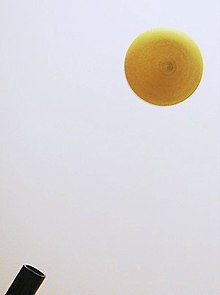
A spinning ping pong ball is held in a diagonal stream of air past the Coandă consequence. The ball "sticks" to the lower side of the air stream, which stops the ball from falling downwardly. The jet as a whole keeps the brawl some distance from the jet exhaust, and gravity prevents it from beingness blown away.
The Coandă result ( or ) is the tendency of a fluid jet to stay attached to a convex surface. Information technology is named after Romanaian inventor Henri Coandă, who described it as "the tendency of a jet of fluid emerging from an orifice to follow an side by side flat or curved surface and to entrain fluid from the surroundings then that a region of lower pressure develops."[ane] [ii]
Coandă was the offset to recognize the practical application of the phenomenon in aircraft design.[a] [3]
Discovery [edit]
An early description of this phenomenon was provided past Thomas Young in a lecture given to The Regal Society in 1800:
The lateral force per unit area which urges the flame of a candle towards the stream of air from a blowpipe is probably exactly similar to that pressure which eases the inflection of a current of air near an obstacle. Mark the dimple which a slender stream of air makes on the surface of h2o. Bring a convex trunk into contact with the side of the stream and the identify of the dimple will immediately show the electric current is deflected towards the body; and if the body be at freedom to move in every management information technology will be urged towards the current...[b]
A hundred years after, Henri Coandă identified an awarding of the upshot during experiments with his Coandă-1910 aircraft, which mounted an unusual engine he designed. The motor-driven turbine pushed hot air rearward, and Coandă noticed that the airflow was attracted to nearby surfaces. In 1934 Coandă obtained a patent in France for a "method and apparatus for deviation of a fluid into another fluid." The effect was described every bit the "divergence of a plainly jet of a fluid that penetrates some other fluid in the vicinity of a convex wall." The outset official documents that explicitly mention the Coandă effect were two 1936 patents by Henri Coandă.[4] [5] This name was accustomed by the leading aerodynamicist Theodore von Kármán, who had with Coandă a long scientific relationship on aerodynamics problems.[6]
Mechanism [edit]


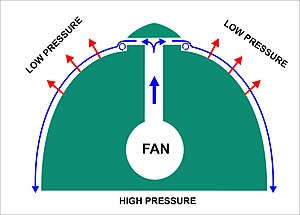
A diagram of a generic engine that harnesses the Coandă Issue to generate lift (or forward motion if tilted 90° on its side). The engine is approximately bullet or inverted bowl shaped, with fluid being expelled horizontally from a circular slit almost the top of the bullet. A small step at the lower border of the slit ensures that a low pressure vortex develops immediately below the point where the fluid exits the slit (meet Diagram 5). From there on the Coandă effect causes the sail of fluid to cling to the curved outer surface of the engine. The entrainment of the ambient fluid into the stream flowing over the bullet, causes a depression pressure expanse above the bullet (Diagrams ane–v) . This, together with the ambient ("loftier") pressure below the bullet causes lift, or, if mounted horizontally, forward motility in the direction of the apex of the bullet.[7]
A gratis jet of air entrains molecules of air from its firsthand surround causing an axisymmetrical "tube" or "sleeve" of depression pressure around the jet (run across Diagram i). The resultant forces from this low pressure tube end up balancing any perpendicular flow instability, which stabilises the jet in a straight line. Still, if a solid surface is placed close, and approximately parallel to the jet (Diagram 2), and then the entrainment (and therefore removal) of air from between the solid surface and the jet causes a reduction in air force per unit area on that side of the jet that cannot be counterbalanced as rapidly as the low pressure region on the "open" side of the jet. The pressure difference across the jet causes the jet to deviate towards the nearby surface, and and then to adhere to it (Diagram 3).[vii] [8] The jet adheres fifty-fifty better to curved surfaces (Diagram 4), because each (infinitesimally minor) incremental change in direction of the surface brings about the effects described for the initial bending of the jet towards the surface.[8] [nine] If the surface is not too sharply curved, the jet tin can, nether the right circumstances, adhere to the surface even afterward flowing 180° round a cylindrically curved surface, and thus travel in a direction opposite to its initial direction. The forces that cause these changes in the direction of flow of the jet cause an equal and opposite force on the surface along which the jet flows.[8] These Coandă consequence induced forces tin can exist harnessed to cause lift and other forms of motion, depending on the orientation of the jet and the surface to which the jet adheres.[7] A small "lip" on the surface at the indicate where the jet starts to menses over that surface (Diagram 5) enhances the initial deviation of the management of flow of the jet, and it subsequently adheres to the surface. This results from the fact that a low pressure vortex forms behind the lip, promoting the dip of the jet towards the surface.[seven]
The Coandă effect can exist induced in any fluid, and is therefore every bit constructive in h2o equally in air.[seven] A heated airfoil significantly reduces drag.[10]
Atmospheric condition of beingness [edit]
Early sources provide data, both theoretical and experimental, needed to derive past comparison a detailed caption of the Coandă outcome and its limits. Coandă effect may occur along a curved wall either in a free jet or a wall jet.
On the left paradigm of the preceding section: "The machinery of Coanda effect", the event equally described, in the terms of T. Young as "the lateral pressure level which eases the inflection of a electric current of air almost an obstacle", represents a free jet emerging from an orifice and an obstacle in the environment. It includes the tendency of a gratuitous jet emerging from an orifice to entrain fluid from the surround confined with express access, without developing any region of lower pressure when there is no obstruction in the surroundings, equally is the case on the reverse side where turbulent mixing occurs at ambient pressure.
On the right image, the issue occurs forth the curved wall as a wall jet. The image here on the right represents a two dimensional wall jet between two parallel plane walls, where the "obstacle" is a quarter cylindrical portion post-obit the flat horizontal rectangular orifice, so that no fluid at all is entrained from the surroundings along the wall, but only on the opposite side in turbulent mixing with ambient air.
Wall jet [edit]
To compare experiment with a theoretical model, a two-dimensional airplane wall jet of width h along a circular wall of radius r is referred to. A wall jet follows a flat horizontal wall, say of infinite radius, or rather whose radius is the radius of the World without separation because the surface pressure too as the external pressure in the mixing zone is everywhere equal to the atmospheric pressure and the purlieus layer does not separate from the wall.

Measurements of surface force per unit area along a circularly curved wall of radius r = 12 cm, deflecting a turbulent jet of air (Reynolds number = xhalf-dozen) of width h. The pressure begins to fall earlier the origin of the jet, due to local effects at the bespeak of leave of the air from the nozzle which creates the jet. If the h/r ratio (ratio of the width of the jet to the radius of curvature of the wall) is less than 0.5, a true Coandă effect is observed, with the wall pressures along the curved wall remaining at this low (sub-ambient force per unit area) level until the jet reaches the end of the wall (when the pressure level quickly returns to ambient force per unit area). If the h/r ratio is more than 0.five, but the local effects occur at the origin of the jet, later on which the jet immediately separates from the wall, and there is no Coandă effect. Experiments past M. Kadosch and J. Liermann in M. Kadosch'southward laboratory, SNECMA.[11]
With a much smaller radius (12 centimeters in the image on the right) a transverse difference arises between external and wall surface pressures of the jet, creating a force per unit area gradient depending upon h/r, the relative curvature. This pressure slope tin appear in a zone before and afterwards the origin of the jet where it gradually arises, and disappear at the point where the jet boundary layer separates from the wall, where the wall force per unit area reaches atmospheric pressure level (and the transverse gradient becomes zippo).
Experiments made in 1956 with turbulent air jets at a Reynolds number of 106 at various jet widths (h) testify the pressures measured along a circularly curved wall (radius r) at a series of horizontal distance from the origin of the jet (see the diagram on the correct).[xi] [12]
Above a disquisitional h/r ratio of 0.v only local effects at the origin of the jet are seen extending over a small angle of xviii° forth the curved wall. The jet then immediately separates from the curved wall. A Coandă effect is therefore not seen hither only simply a local zipper: a pressure level smaller than atmospheric pressure appears on the wall along a distance corresponding to a small angle of ix°, followed by an equal angle of 9° where this pressure increases up to atmospheric pressure at the separation of the boundary layer, subject to this positive longitudinal gradient. Notwithstanding, if the h/r ratio is smaller than the critical value of 0.5, the lower than ambient force per unit area measured on the wall seen at the origin of the jet continues along the wall (until the wall ends –; see diagram on the right). This is "a true Coandă effect" as the jet clings to the wall "at a nearly abiding pressure" as in a conventional wall jet.
A calculation fabricated by Forest in 1954[13] of an inviscid flow forth a circular wall shows that an inviscid solution exists with whatsoever curvature h/r and any given deflection angle up to a separation signal on the wall, where a singular point appears with an infinite slope of the surface pressure curve.

Pressure distribution forth the round wall of a wall jet
Introducing in the calculation the angle at separation institute in the preceding experiments for each value of the relative curvature h/r , the image here was recently obtained,[14] and shows inertial effects represented by the inviscid solution: the calculated pressure level field is similar to the experimental one described higher up, outside the nozzle. The menstruum curvature is acquired exclusively by the transverse pressure gradient, as described past T. Immature. And then, viscosity just produces a purlieus layer along the wall and turbulent mixing with ambient air as in a conventional wall jet—except that this purlieus layer separates under the action of the difference between the finally ambient pressure and a smaller surface pressure level along the wall. According to Van Dyke,[15] as quoted in Lift (strength), the derivation of his equation (4c) also shows that the contribution of gummy stress to menstruum turning is negligible.
An culling way would be to summate the deflection angle at which the purlieus layer subjected to the inviscid force per unit area field separates. A rough adding has been tried that gives the separation angle as a role of h/r and the Reynolds number:[12] The results are reported on the epitome, e.g., 54° calculated instead of 60° measured for h/r=0.25. More experiments and a more authentic boundary layer calculation would exist desirable.
Other experiments made in 2004 with a wall jet along a circular wall testify that Coandă effect does non occur in a laminar flow, and the disquisitional h/r ratios for small-scale Reynolds numbers are much smaller than those for turbulent menstruation.[xvi] down to h/r=0.14 if Re=500 and h/r=0.05 if Re=100.
Free jet [edit]
L. C. Woods also made the adding of the inviscid two-dimensional menstruum of a costless jet of width h, deflected circular a circularly cylindrical surface of radius r, between a outset contact A and separation at B, including a deflection bending θ. Again a solution exists for any value of the relative curvature h/r and angle θ. Moreover, in the instance of a costless jet the equation can be solved in closed form, giving the distribution of velocity forth the circular wall. The surface pressure distribution is then calculated using Bernoulli equation. Let u.s. notation p a the pressure and 5 a the velocity forth the free streamline at the ambience pressure, and γ the angle forth the wall which is cipher in A and θ in B. Then the velocity 5 is found to be:
![{\displaystyle {\frac {v}{v_{a}}}=\exp {\bigg [}{2h \over \pi r}\tan ^{-1}{\bigg (}{\big [}{\sinh ^{2}({\pi \theta r \over 4h})-\cosh ^{2}({\pi \theta r \over 4h})\tanh ^{2}({\pi \gamma r \over 4h})}{\big ]}^{1/2}{\bigg )}{\bigg ]}}](https://wikimedia.org/api/rest_v1/media/math/render/svg/315ce57dfbed57057657b1dc331ea1d4e5afcac1)
An image of the surface pressure distribution of the jet round the cylindrical surface using the same values of the relative curvature h/r, and the same angle θ as those found for the wall jet reported in the image on the right side hither has been established: it may be found in reference (xv) p. 104 and both images are quite similar : Coanda event of a free jet is inertial, the same as Coanda upshot of a wall jet. All the same, an experimental measurement of the corresponding surface force per unit area distribution is not known.
Experiments in 1959 by Bourque and Newmann[17] concerning the reattachment of a two-dimensional turbulent jet to an offset parallel plate later enclosing a separation bubble where a depression pressure vortex is confined (equally in the image v in the preceding department) and too for a two-dimensional jet followed past a single flat plate inclined at an bending instead of the circularly curved wall in the diagram on the correct here describing the experience of a wall jet: the jet separates from the plate, and then curves towards the plate when the surrounding fluid is entrained and pressure lowered, and eventually reattaches to information technology, enclosing a separation bubble. The jet remains free if the angle is greater than 62°.
In this last case which is the geometry proposed by Coanda, the claim of the inventor is that the quantity of fluid entrained by the jet from the surroundings is increased when the jet is deflected, a characteristic exploited to improve the scavenging of internal combustion engines, and to increase the maximum elevator coefficient of a wing, equally indicated in the applications beneath.
The surface force per unit area distribution every bit well every bit the reattachment distance accept been duly measured in both cases, and two guess theories have been developed for the mean pressure within the separation bubble, the position of reattachment and the increment in volume flow from the orifice: the agreement with experiment was satisfactory.
Applications [edit]
The Coandă effect has applications in various high-lift devices on shipping, where air moving over the fly can be "bent down" towards the ground using flaps and a jet canvass blowing over the curved surface of the top of the wing. The bending of the flow results in aerodynamic lift.[18] The flow from a high speed jet engine mounted in a pod over the wing produces increased lift by dramatically increasing the velocity slope in the shear flow in the boundary layer. In this velocity slope, particles are diddled away from the surface, thus lowering the pressure there. Closely following the work of Coandă on applications of his research, and in particular the work on his "Aerodina Lenticulară,"[19] John Frost of Avro Canada also spent considerable time researching the result, leading to a series of "inside out" hovercraft-like aircraft from which the air exited in a ring around the outside of the aircraft and was directed by being "attached" to a flap-like ring.
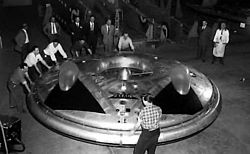
This is equally opposed to a traditional hovercraft design, in which the air is diddled into a central surface area, the plenum, and directed down with the use of a fabric "skirt." Only i of Frost's designs was ever built, the Avrocar.
The VZ-9 AV Avrocar (often listed as VZ-9) was a Canadian vertical takeoff and landing (VTOL) aircraft adult past Avro Aircraft Ltd. every bit part of a secret United States military project carried out in the early on years of the Cold War.[20] The Avrocar intended to exploit the Coandă outcome to provide lift and thrust from a single "turborotor" blowing exhaust out the rim of the disk-shaped shipping to provide anticipated VTOL-like performance. In the air, it would have resembled a flying saucer. Two prototypes were congenital as "proof-of-concept" test vehicles for a more than advanced U.Southward. Air Force fighter and also for a U.South. Army tactical gainsay aircraft requirement.[21]
Avro'southward 1956 Project 1794 for the U.S. armed services designed a larger-scale flying saucer based on the Coandă effect and intended to reach speeds betwixt Mach 3 and Mach 4.[22] Project documents remained classified until 2012.
The effect was also implemented during the.S. Air Force's Advanced Medium STOL Ship (AMST) project. Several aircraft, notably the Boeing YC-14 (the first modern type to exploit the upshot), NASA's Repose Short-Haul Research Aircraft, and the National Aerospace Laboratory of Nippon's Asuka research aircraft accept been built to have advantage of this effect, by mounting turbofans on the top of the wings to provide high-speed air even at low flying speeds, merely to date only 1 aircraft has gone into production using this system to a major degree, the Antonov An-72 "Coaler." The Shin Meiwa United states-1A flying boat utilizes a similar organisation, only it directs the propwash from its 4 turboprop engines over the acme of the wing to generate depression-speed lift. More uniquely, information technology incorporates a 5th turboshaft engine within of the wing center-section solely to provide air for powerful blown flaps. The add-on of these two systems gives the aircraft an impressive STOL adequacy.
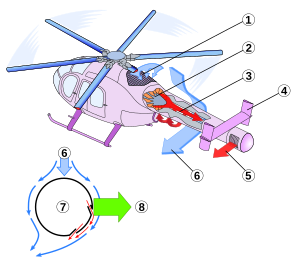
A Coandă engine (items three,six–8) replaces the tail rotor in the NOTAR helicopter. i Air intake ii Variable pitch fan 3 Tail smash with Coandă Slots four Vertical stabilizers v Direct jet thruster 6 Downwash 7 Circulation control tailboom cross-section eight Anti-torque lift

A depiction of the Blackburn Buccaneer shipping. Blowing slots at the leading edges of the fly, tailplane and trailing border flaps/ ailerons are highlighted. These aerodynamic features contribute to the Coandă airflow over the wing

The C-17 Globemaster III has externally diddled flaps with part of the engine period passing through the flap slots to be turned over the superlative surfaces past the Coandă effect
The experimental McDonnell Douglas YC-fifteen and its production derivative, the Boeing C-17 Globemaster Iii, also utilise the event. The NOTAR helicopter replaces the conventional propeller tail rotor with a Coandă effect tail (diagram on the left).
A better understanding of Coandă upshot was provided by the scientific literature produced by ACHEON EU FP7 projection.[23] This projection utilized a particular symmetric nozzle to produce an constructive modeling of the Coandă outcome,[24] [25] [26] and adamant innovative STOL shipping configurations based on the effect.[27] [28] This action has been expanded by Dragan in the turbomachinery sector, with the objective of better optimizing the shape of rotating blades past Rumanian Comoti Inquiry Centre'southward piece of work on turbomachinery.[29] [30]
A practical use of the Coandă consequence is for inclined hydropower screens,[31] which separate debris, fish, etc., otherwise in the input flow to the turbines. Due to the slope, the debris falls from the screens without mechanical clearing, and due to the wires of the screen optimizing the Coandă result, the water flows through the screen to the penstocks leading the water to the turbines.
The Coandă event is used in dual-design fluid dispensers in automobile windshield washers.[32]
The operation principle of oscillatory flowmeters also relies on the Coandă phenomenon. The incoming liquid enters a chamber that contains two "islands." Due to the Coandă effect, the main stream splits up and goes nether one of the islands. This flow then feeds itself back into the chief stream making information technology split up up again, but in the direction of the second isle. This process repeats itself as long as the liquid circulates the chamber, resulting in a self-induced oscillation that is directly proportional to the velocity of the liquid and consequently the volume of substance flowing through the meter. A sensor picks up the frequency of this oscillation and transforms it into an analog bespeak yielding volume passing through.[33]
In air conditioning, the Coandă upshot is exploited to increment the throw of a ceiling mounted diffuser. Because the Coandă effect causes air discharged from the diffuser to "stick" to the ceiling, it travels farther before dropping for the same discharge velocity than it would if the diffuser were mounted in gratis air, without the neighbouring ceiling. Lower discharge velocity means lower noise levels and, in the example of variable air volume (VAV) ac systems, permits greater turndown ratios. Linear diffusers and slot diffusers that present a greater length of contact with the ceiling exhibit a greater Coandă effect.
In cardiovascular medicine, the Coandă effect accounts for the split up streams of blood in the fetal correct atrium.[34] It too explains why eccentric mitral regurgitation jets are attracted and dispersed along adjacent left atrial wall surfaces (so called "wall-hugging jets" every bit seen on echocardiographic color-doppler interrogation). This is clinically relevant considering the visual area (and thus severity) of these eccentric wall-hugging jets is often underestimated compared to the more readily credible central jets. In these cases, volumetric methods such as the proximal isovelocity expanse (PISA) method are preferred to quantify the severity of mitral regurgitation.
In medicine, the Coandă issue is used in ventilators.[35] [36] [37]
In meteorology, the Coandă effect theory has also been applied to some air streams flowing out of mount ranges such as the Carpathian Mountains and Transylvanian Alps, where effects on agriculture and vegetation accept been noted. It also appears to be an effect in the Rhone Valley in France and near Large Delta in Alaska.[38]
In Formula I machine racing, the Coandă consequence has been exploited by the McLaren, Sauber, Ferrari and Lotus teams, later the get-go introduction by Adrian Newey (Red Bull Team) in 2011, to assist redirect exhaust gases to run through the rear diffuser with the intention of increasing downforce at the rear of the car.[39] Due to changes in regulations fix in place by the FIA from the beginning of the 2014 Formula One flavor, the intention of redirecting exhaust gases to use the Coandă effect have been negated, due to the mandatory requirement that the auto exhaust not have bodywork intended to contribute to aerodynamic upshot situated directly behind it.[40]
In fluidics, the Coandă effect was used to build bistable multivibrators, where the working stream (compressed air) stuck to one curved wall or another and control beams could switch the stream betwixt the walls.
The Coandă effect is also used to mix two dissimilar fluids in a Coandă effect mixer.[41] [42]
Practical sit-in [edit]
The Coandă effect tin can be demonstrated past directing a small jet of air upwards at an angle over a ping pong brawl. The jet is drawn to and follows the upper surface of the ball curving around it, due to the (radial) acceleration (slowing and turning) of the air around the ball. With plenty airflow, this alter in momentum is balanced past the equal and contrary forcefulness on the ball supporting its weight. This sit-in tin can be performed using a hairdryer on the lowest setting or a vacuum cleaner if the outlet tin can exist attached to the pipe and aimed upwards at an bending.
A mutual misconception is that the Coandă result is demonstrated when a stream of tap water flows over the back of a spoon held lightly in the stream and the spoon is pulled into the stream (for instance, Massey 1979, Fig 3.12 uses the Coandă effect to explain the deflection of water around a cylinder). While the flow looks very similar to the air catamenia over the ping pong ball in a higher place (if one could encounter the air period), the cause is not really the Coandă effect. Here, because it is a flow of water into air, there is footling entrainment of the surrounding fluid (the air) into the jet (the stream of water). This particular demonstration is dominated by surface tension. (McLean 2012, Figure vii.3.vi states that the h2o deflection "actually demonstrates molecular attraction and surface tension.")
Some other demonstration is to direct the air flow from, e.thousand., a vacuum cleaner operating in contrary, tangentially past a circular cylinder. A waste basket works well. The air flow seems to "wrap effectually" the cylinder and can be detected at more than 180° from the incoming flow. Under the correct conditions, catamenia rate, weight of the cylinder, smoothness of the surface it sits on, the cylinder really moves. Note that the cylinder does not movement directly into the flow as a misapplication of the Bernoulli outcome would predict, but at a diagonal.
The Coandă effect tin too be demonstrated past placing a can in front end of a lit candle, such that when 1'south line of sight is along the tiptop of the can, the candle flame is completely hidden from view behind it. If one then blows straight at the can, the candle will be extinguished despite the tin existence "in the way". This is because the airflow directed at the can bends around it and still reaches the candle to extinguish it, in accordance with the Coandă outcome.
Problems caused [edit]
The engineering use of Coandă effect has disadvantages as well every bit advantages.
In marine propulsion, the efficiency of a propeller or thruster can be severely curtailed by the Coandă effect. The force on the vessel generated past a propeller is a function of the speed, volume and direction of the water jet leaving the propeller. Under certain weather (e.g., when a ship moves through water) the Coandă outcome changes the management of a propeller jet, causing it to follow the shape of the transport's hull. The side force from a tunnel thruster at the bow of a ship decreases rapidly with forward speed.[c] The side thrust may completely disappear at speeds higher up most 3 knots.[43] If the Coandă effect is practical to symmetrically shaped nozzles, it presents resonation issues. Those issues and how different spins couple accept been analyzed in depth.[28]
Meet also [edit]
- Aerodynamics
- Airfoil
- Boundary layer
- Apportionment control wing
- Fluid dynamics
- Fluid friction
- Lift (strength)
- Magnus result
- Microelectromechanical systems
- Microfluidics
- NOTAR
- Tesla valve
- Trench effect
References [edit]
Notes [edit]
- ^ "The Coanda effect is a miracle that was get-go observed in 1910 by a mathematician and engineer named Henri Coandă. He discovered that when air was ejected from a rectangular nozzle, it would attach itself to an inclined flat plate connected to the nozzle exit. Emphasizing the need for a abrupt angle between the nozzle and the flat plate, Coandă then applied the principle to a series of deflecting surfaces, each at a abrupt bending to the previous i, and succeeded in turning flows through angles equally large as 180. He stated that "when a jet of fluid is passed over a curved surface, it bends to follow the surface, entraining large amounts of air as it does so," and this phenomenon has become known every bit the Coandă Issue.(Lubert 2011, pp. 144–153)
- ^ The pressure of the air jet is really supplementing the pressure of the atmosphere, a.one thousand.a. The Atmospheric Printing, which at fourteen.7psi at sea level makes water or other liquids lay smooth. Accident on a function of the water and the pressure is increased a slight amount which naturally makes the water move away. Direct a flame parallel over a liquid or submerge a candle almost to its wick and the liquid will be seen to ascension slightly as the heat of the flame lessens the Atmospheric Press pressing on the water. The hotter the flame and the closer to the surface the greater the effect will be seen.(Young 1800)
- ^ This problem tin can be solved by an authentic pattern of both the propeller and the hull that is specifically optimized on a fluiddynamic point of view. (Lehn 1992)
Citations [edit]
- ^ Tritton, D.J., Physical Fluid Dynamics, Van Nostrand Reinhold, 1977 (reprinted 1980), Department 22.7, The Coandă Outcome.
- ^ "Definition of COANDA EFFECT".
- ^ "Coandă upshot". Columbia Electronic Encyclopedia (6th ed.). 2013. Archived from the original on 2012-01-eighteen.
- ^ Coanda, H. "US Patent# 2,052,869." Device for Deflecting a Stream of Elastic Fluid Projected into an Rubberband Fluid (1936).
- ^ Coanda H. (1936a), Us Patent northward. iii,261,162, Lifting Device Coanda Effect, The states
- ^ Eisner, Thomas (2005), For Love of Insects, Harvard University Press, p. 177, ISBN978-0-674-01827-iii
- ^ a b c d due east Reba, Imants (June 1966). "Applications of the Coanda effect". Scientific American. 214 (half dozen): 84–921. Bibcode:1966SciAm.214f..84R. doi:x.1038/scientificamerican0666-84.
- ^ a b c Coanda Effect Retrieved 17 November 2017
- ^ Jeff Raskin: Coanda Effect: Agreement how wings work. Retrieved 17 November 2017
- ^ Drinkall, Timothy. "Increasing Aerofoil Lift via Artificial Amplification of the Coanda Outcome Using Heat". Abstract: Search ISEF Projects Database, Finalist Abstract. Society for Science. Archived from the original on eight June 2021. Retrieved 8 June 2021.
{{cite spider web}}: CS1 maint: bot: original URL status unknown (link) - ^ a b Kadosch M., Déviation d'un jet par adhérence à une paroi convexe in Journal de Physique et le Radium, avril 1958, Paris, pp.ane–12A
- ^ a b Kadosch M., "The curved wall upshot" in 2nd Cranfield Fluidics Briefing, Cambridge, three janvier 1967
- ^ L. C. Wood, Compressible subsonic menstruum in 2-dimensional channels with mixed boundary conditions, in Quart. Journ. Mech. And Practical Math., 7, 3, p. 263–282, 1954
- ^ Kadosch K., Illusions créatrices, CreateSpace & Kindle, 2015, Ch. eight, Coandă et le jet qui soulève les aeronefs, p. 91 to 112
- ^ M. Van Dyke (1969), Higher-Gild Purlieus-Layer Theory, Annual Review of Fluid Mechanics
- ^ Vit, T.; Marsik, F. (Baronial 15–21, 2004). "Experimental and Theoretical Study of Heated Coandă Jet". XXI International Congress of Theoretical and Applied Mechanics.
- ^ Bourque, C.; Newmann, B. G. (August 1960). "Reattachment of a ii-dimensional, incompressible jet to an adjacent flat Plate". The Aeronautical Quarterly. 11 (3): 201–232. doi:10.1017/S0001925900001797.
- ^ "Lift from Period Turning". NASA Glenn Research Eye. Archived from the original on 2011-07-05.
- ^ Fluid Dynamics by Mihaela-Maria Tanasescu, Texas Tech University
- ^ Yenne 2003, pp. 281–283.
- ^ Milberry 1979, p. 137.
- ^ The states Air Force's 1950s supersonic flight saucer declassified
- ^ ACHEON-Aerial Coanda Loftier Efficiency Orienting jet Nozzle, European Commission, Project reference: 309041, Funded under: FP7." Send (2011).
- ^ Trancossi et al. 2014, p. 83.
- ^ Das et al. 2014, p. 181–202.
- ^ Subhash & Dumas 2013, pp. 260–272.
- ^ Trancossi et al. 2016.
- ^ a b Das et al. 2015.
- ^ Dragan 2014b, pp. 35–41.
- ^ Dragan 2014a, p. 25.
- ^ Hydropower in the U.S. Archived 2010-06-21 at the Wayback Car, Coandă effect used in debris screen design.
- ^ US 4210283 "Dual design windshield washer nozzle"
- ^ Spitzer, David Westward. "Industrial Flow measurement." Musical instrument Club of America, 1990.
- ^ Ashrafian 2006, p. 300.
- ^ Qudaisat, I.Y. (2008). "Coanda result as an explanation for unequal ventilation of the lungs in an intubated patient?". British Journal of Anaesthesia. 100 (6): 859–860. doi:10.1093/bja/aen111. PMID 18483115.
- ^ "Fluidic ventilator".
- ^ Rangappa 2009, p. 486.
- ^ Giles 1977, pp. 273–279.
- ^ "McLaren MP4-27 - exhaust positioning". Formula one. Archived from the original on 2012-03-25.
- ^ "2012 flavour changes". Formula one. Archived from the original on 2012-03-11.
- ^ Hong, Chien-Chong; Choi, Jin-Woo; Ahn, Chong H. (2004). "A novel in-plane passive microfluidic mixer with modified Tesla structures". Lab on a Chip. 4 (two): 109–13. doi:10.1039/b305892a. ISSN 1473-0197. PMID 15052349.
- ^ Hong, Chien-Chong; Choi, Jin-Woo; Ahn, Chong H. (2001), "A Novel In-Aeroplane Passive Micromixer Using Coanda Effect", Micro Total Analysis Systems 2001, Springer Netherlands, pp. 31–33, doi:ten.1007/978-94-010-1015-3_11, ISBN9789401038935
- ^ Clarke, I. C. (2005), Ship Dynamics for Mariners, London: The Nautical Establish
Sources [edit]
- Ashrafian, Hutan (2006). "The Coanda Effect and Preferential Correct Atrial Streaming". Breast. 130 (1): 300. doi:x.1378/chest.130.1.300. ISSN 0012-3692. PMID 16840419.
- Das, Shyam; Abdollahzadeh, K.; Pascoa, Jose; Dumas, A.; Trancossi, M. (2014). "Numerical modeling of coanda effect in a novel propulsive organisation". The International Periodical of Multiphysics. 8 (2): 181–202. doi:x.1260/1750-9548.8.2.181. ISSN 1750-9548.
- Das, Shyam Southward.; Páscoa, Jose C.; Trancossi, Grand.; Dumas, A. (2015). "Computational Fluid Dynamic Study on a Novel Propulsive System: ACHEON and Its Integration with an Unmanned Aerial Vehicle (UAV)". Periodical of Aerospace Applied science. 29 (1): 04015015. doi:x.1061/(ASCE)Every bit.1943-5525.0000498. ISSN 0893-1321.
- Dragan, V. (2014a). "Notes regarding the definition and applicability of supercirculation" (PDF). INCAS Balderdash. six (2): 25–32. doi:10.13111/2066-8201.2014.six.2.three.
- Dragan, V. (2014b). "Reynolds number adding and applications for curved wall jets" (PDF). INCAS Bull. half dozen (three): 35–41. doi:ten.13111/2066-8201.2014.half dozen.3.4.
- Giles, B. D. (1977). "Fluidics, the Coanda Effect, and some orographic winds". Archiv für Meteorologie, Geophysik und Bioklimatologie, Serie A. 25 (3): 273–279. Bibcode:1977AMGBA..25..273G. doi:10.1007/BF02321800. ISSN 0066-6416. S2CID 124178075.
- Lehn, E. (1992), Practical methods for estimation of thrust losses, Trondheim, Norway: Marintek (Norwegian Marine Technology Research Plant), report number 513003.00.06
- Lubert, Caroline (2011), "On Some Contempo Applications of the Coanda Upshot" (PDF), International Journal of Acoustics and Vibration, 16 (3), doi:10.20855/ijav.2011.16.3286
- Massey, Bernard Stanford (1979). Mechanics of Fluids (quaternary ed.). New York: Van Nostrand Reinhold Company. ISBN978-0-442-30245-0.
- McLean, Doug (2012). Understanding Aerodynamics: Arguing from the Real Physics. Chichester: John Wiley & Sons. ISBN978-one-119-96751-4.
- Rangappa, Pradeep (June 2009). "Anaestheisa and Critical Intendance" (PDF). Periodical of the Clan of Physicians of India. 57: 486. Archived from the original (PDF) on 2013-03-24.
- Subhash, Maharshi; Dumas, Antonio (2013). "Computational Study of Coanda Adhesion Over Curved Surface". SAE International Journal of Aerospace. 6 (ane): 260–272. doi:10.4271/2013-01-2302. ISSN 1946-3901.
- Trancossi, Michele; Dumas, Antonio; Das, Shyam Sumantha; Pascoa (2014). "Design methods of Coanda effect nozzle with ii streams" (PDF). INCAS Bulletin. 6 (i): 83–95. doi:10.13111/2066-8201.2014.6.1.8.
- Trancossi, Michele; Madonia, Mauro; Dumas, Antonio; Angeli, Diego; Bingham, Chris; Das, Shyam Sumanta; Grimaccia, Francesco; Marques, Jose Pascoa; Porreca, Eliana; Smith, Tim; Stewart, Paul; Subhash, Maharshi; Sunol, Anna; Vucinic, Dean (2016). "A new shipping compages based on the ACHEON Coanda upshot nozzle: flight model and energy evaluation". European Transport Research Review. 8 (2). doi:x.1007/s12544-016-0198-four. hdl:11380/1116374. ISSN 1867-0717. S2CID 54063478.
- Young, Thomas (1800), Outlines of experiments and inquiries respecting sound and light
External links [edit]
- Flight 1945
- Coandă effect video (one)
- Coandă effect video (2)
- Information on the patents of Coandă
- New Uk based UAV project utilising the Coandă effect
- Report on the Coandă Event and lift
- How to see the Coandă effect at home (www.physics.org comic)
Source: https://en.wikipedia.org/wiki/Coand%C4%83_effect

Post a Comment for "Side Effect of a Home Again Chip"